
In a recent LinkedIn post, sales trainer John Barrows challenges the long-standing sales practice of leading with Return on Investment (ROI) calculations, arguing that such figures are often unbelievable and fail to create genuine urgency. Barrows suggests a shift towards quantifying the Cost of Inaction (COI) as a more effective strategy for sales professionals.
Barrows begins by highlighting the inherent skepticism buyers have towards vendor-provided ROI projections, which he describes as typically featuring unrealistic “hockey stick” growth curves.
“Every vendor walks in with the same hockey stick projection, and your buyer knows exactly how many assumptions are hiding inside it like a perfect implementation, full adoption, ideal timing and more.”
He elaborates on the difficulty of projecting future savings, especially in the current era of rapid technological change, particularly with the advent of AI.
“In this age of AI, can anyone here genuinely tell me what ‘the future’ is going to look like? People talk about a 12 month ROI…..I can barely think about what 12 days from now is going to look like, never mind 12 months.”
According to Barrows, the true driver of urgency in a sales conversation is not the potential upside promised by ROI, but rather the current pain and cost associated with maintaining the status quo. He refers to this as the Cost of Inaction (COI).
The Limitations of ROI in Modern Sales
John Barrows contends that ROI, by its nature, is a future promise tied to a present cost. He points out that the assumptions embedded in these calculations—such as perfect implementation, full user adoption, and ideal market timing—are often unrealistic and easily seen through by experienced buyers. This skepticism, Barrows argues, undermines the effectiveness of ROI as a persuasive tool.
Furthermore, Barrows questions the validity of short-term ROI projections in a world characterized by unpredictable change, especially with the rapid advancements in artificial intelligence. He suggests that forecasting financial benefits a year into the future is nearly impossible when even short-term outlooks are highly uncertain.
Shifting Focus to the Cost of Inaction (COI)
Barrows advocates for a strategic pivot from discussing ROI to quantifying the Cost of Inaction. He explains that urgency is best created by illustrating what a potential client is currently losing by *not* acting, rather than by promising future gains. This approach, he notes, is often overlooked by sales representatives.
“This is also one of the main reasons reps struggle to create urgency. Urgency never comes from the upside you’re promising (ROI). It comes from what staying the same is already costing your buyer (COI – Cost of Inaction), and most reps never put a number on it.”
He shares a personal anecdote about how his own past attempts to counter price objections with the idea that “one deal pays for itself” were met with buyer agreement but ultimately failed to close deals, indicating that the perceived value wasn’t strong enough.
A Framework for Identifying COI
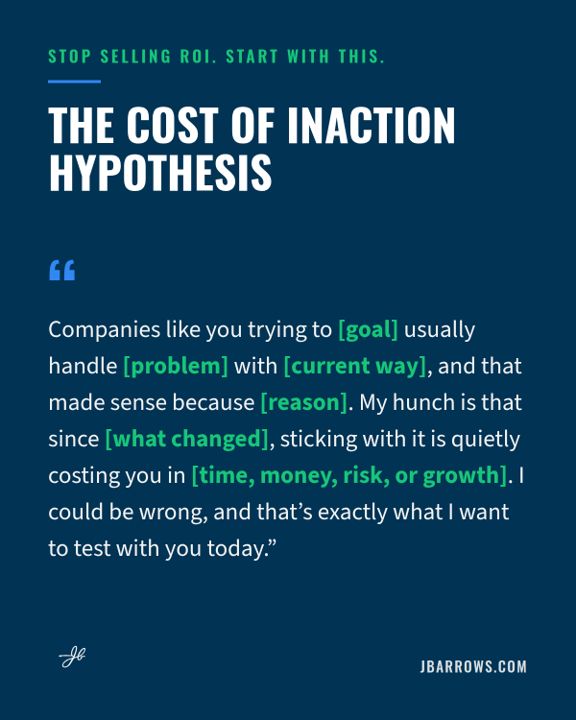
To assist sales professionals in this shift, Barrows outlines a specific framework for structuring conversations around COI. This involves understanding the client’s goals, the problem that hinders those goals, their current method of handling the problem, and why that method was once appropriate. The crucial step is then identifying what has changed to make the current approach costly.
“Companies like you trying to [goal] usually handle [problem] with [current way], and that made sense because [reason]. My hunch is that since [what changed], sticking with it is quietly costing you in [time, money, risk, or growth]. I could be wrong, and that’s exactly what I want to test with you today.”
Barrows emphasizes that filling in these blanks constitutes essential meeting preparation. He believes that by helping clients calculate their own Cost of Inaction, sales reps can make the realization their own, likening the process to planting an idea as seen in the movie *Inception*.
He concludes by offering resources to those interested in learning more about this methodology, suggesting that this approach, especially when aided by AI tools, can significantly differentiate a sales representative.
📝 About This Content
This article is based on insights shared by John Barrows on LinkedIn.
📅 Originally posted on July 28, 2026 | View original post on LinkedIn →