
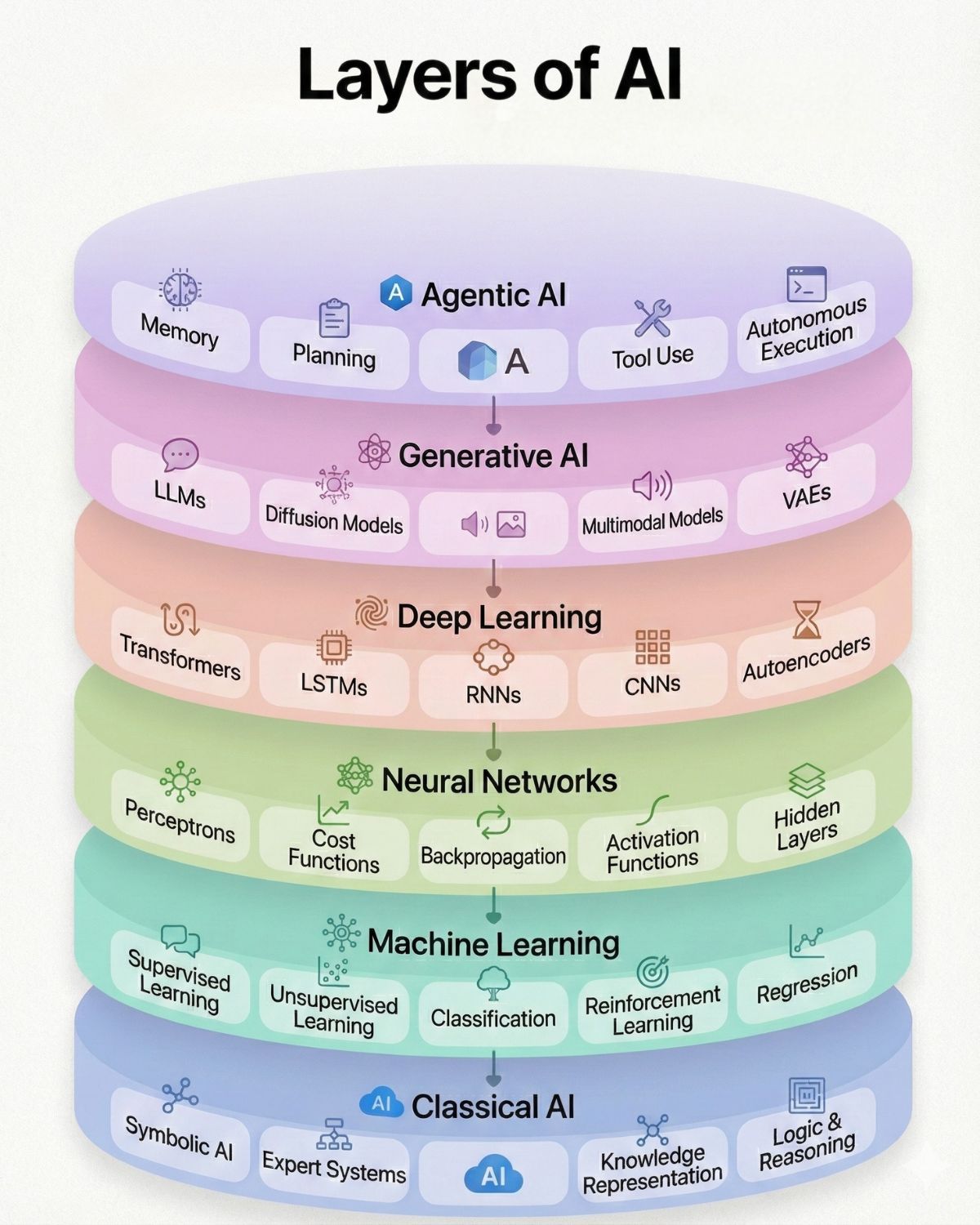
In a recent LinkedIn post, Luís Rodrigues demystifies the complex landscape of Artificial Intelligence by breaking it down into a foundational “stack” of layered technologies. Rodrigues emphasizes that AI is not a monolithic entity but rather a progression of capabilities, each building upon the last. He cautions against viewing AI through a magical lens, stating, “AI isn’t magic. It’s a stack.”
Understanding the AI Layers
Luís Rodrigues outlines six distinct layers in the evolution of AI, beginning with the most fundamental. He explains:
“𝗖𝗹𝗮𝘀𝘀𝗶𝗰𝗮𝗹 𝗔𝗜. Pure logic. “If this, then that”. Symbolic AI and Expert Systems that follow rigid rules to make decisions. It doesn’t learn, it just follows the rules.”
This initial layer, as described by Rodrigues, relies on predefined rules rather than adaptive learning. Moving beyond this, he introduces Machine Learning as a significant shift.
The Shift to Learning from Data
Rodrigues highlights that Machine Learning marked a departure from explicit rule-writing, instead leveraging mathematical algorithms to identify patterns within data. “We stopped writing rules and started using math,” he notes. This approach allows systems to classify, predict, and optimize based on historical information, a fundamental difference from the rigid logic of Classical AI.
Mimicking Biology and Processing Complexity
The evolution continued with Neural Networks, which Rodrigues explains were inspired by the structure of the human brain. He points out their significance in processing complex and unstructured data:
“We built systems inspired by the human brain with nodes and connections. This layer allowed computers to begin processing complex, messy inputs like signals and raw pixel data.”
This advancement paved the way for Deep Learning, where massive neural networks, including Transformers and LSTMs, became the driving force behind breakthroughs in areas like computer vision and natural language processing. Rodrigues refers to this as the “engine room” for these capabilities.
From Analysis to Creation and Action
The most recent layers, Generative AI and Agentic AI, represent a paradigm shift. Generative AI, as Luís Rodrigues explains, moves beyond mere analysis to creation. “These models don’t just classify a cat, they can draw one. They write code, draft emails, and compose music,” he writes, identifying this layer as the one that captured public attention.
Looking towards the frontier, Rodrigues introduces Agentic AI. He posits that while Generative AI focuses on output, Agentic AI focuses on action. According to Rodrigues:
“Agentic AI acts. These systems possess memory, planning capabilities, and tool use. They move beyond passive output to autonomous execution. They do the work for you.”
The Future of AI as Employees
Rodrigues concludes his analysis with a crucial point about the foundational nature of these AI layers. “You cannot understand the penthouse if you ignore the foundation,” he asserts, underscoring the importance of understanding the entire stack. He suggests that the industry is currently transitioning from the Generative era to the Agentic era, leading to a future where AI models function more like autonomous employees.
His post prompts readers to consider their current engagement with AI, asking, “Where are you spending most of your time right now?” This question encourages reflection on how individuals and businesses are adapting to these rapidly evolving AI capabilities.
📝 About This Content
This article is based on insights shared by Luís Rodrigues on LinkedIn.
📅 Originally posted on September 6, 2026 | View original post on LinkedIn →