
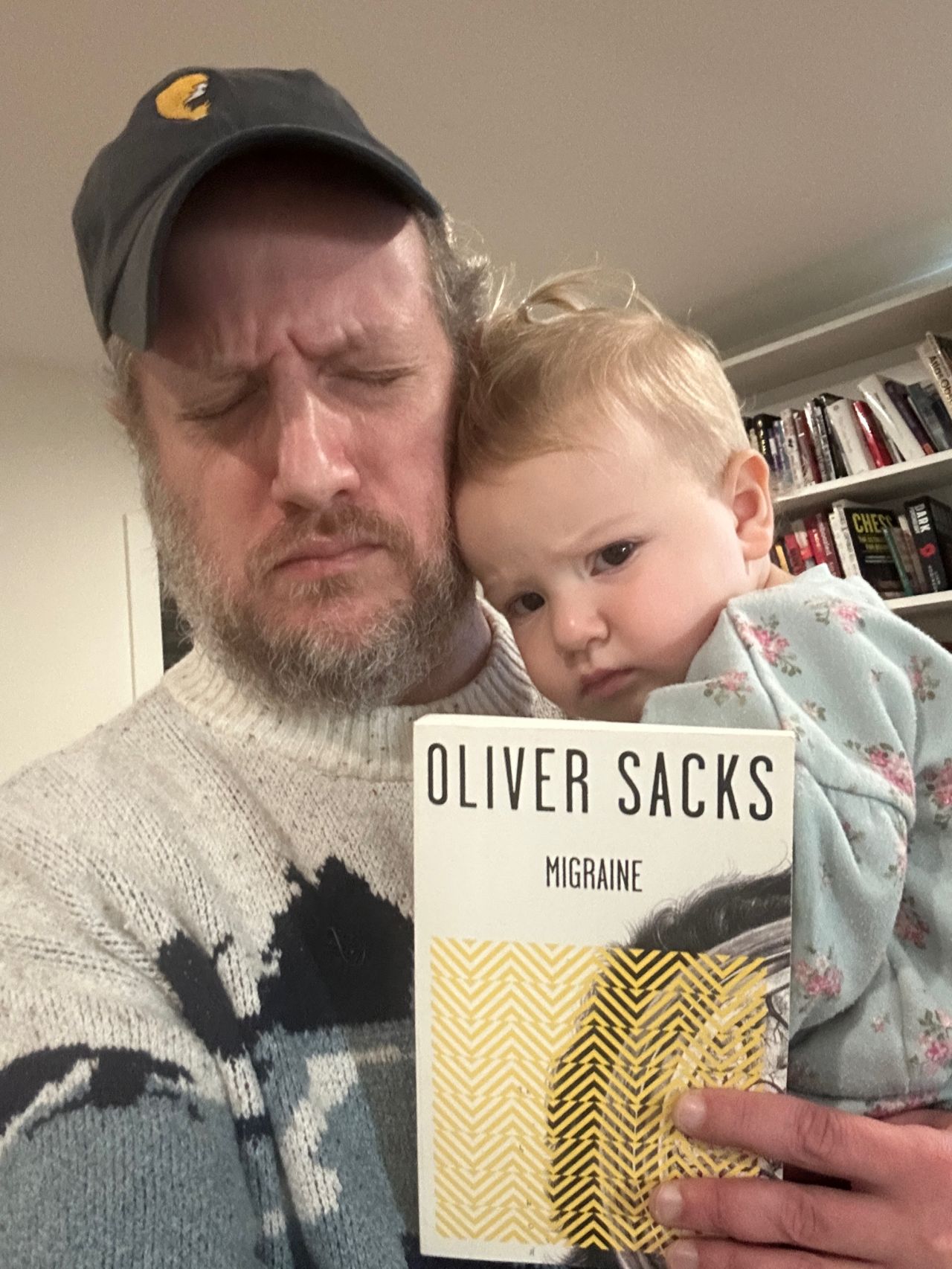
In a recent LinkedIn post, Justin Oberman explores a provocative connection between migraine sufferers and the future of artificial intelligence, suggesting that those who experience migraines possess a unique capacity for empathy crucial for effective AI interaction. Oberman frames migraines not merely as a physical ailment but as a profound alteration of consciousness.
The Migraine Experience: More Than Just Pain
Oberman begins by challenging the common perception of migraines, stating that they are “not merely about pain.” He elaborates on the transformative nature of the experience, describing it as an “alteration of consciousness so profound they change how you perceive reality itself.” The accompanying auras, he explains, can dissolve the ordinary world, replacing it with something “strange & hallucinatory.” This altered state, Oberman posits, has historically been a source of raw material for creativity, citing historical figures like Thomas Mann’s fictional composer Adrian Leverkühn, the 12th-century abbess Hildegard von Bingen, and authors Lewis Carroll, Virginia Woolf, and Friedrich Nietzsche as individuals who lived intimately with such neurological experiences.
“The auras that accompany them dissolve the ordinary world and replaces it (however briefly) with something strange & hallucinatory.”
Empathy and the ‘Theory of Mind’
Drawing on the work of psychologist Oliver Sacks, Oberman argues that migraines should be viewed as a complex condition with a unique role in an individual’s life, rather than simply an illness. This perspective leads to a discussion on empathy, which Oberman identifies as a critical component for effective creativity and, by extension, for understanding and utilizing AI. He introduces the concept of “Theory of Mind” – the ability to imagine events from another person’s point of view.
For migraine sufferers, Oberman contends, this Theory of Mind is deeply rooted in their embodied experience. “For migraine sufferers like me, this Theory of Mind comes not just from the pain, but from knowing, in our bodies, what it ‘s like when the tools for perception themselves become unreliable,” he writes. This embodied understanding of disrupted perception, he argues, is what makes migraines creatively powerful.
AI’s Inherent Limitation: The Absence of Suffering
The core of Oberman’s argument lies in the inherent limitations of AI in replicating this human capacity for empathy. He starkly contrasts the human experience with that of artificial intelligence: “But AI cannot get migraines. AI experiences no embodied suffering or involuntary disruption of its own cognition.” This fundamental difference, he suggests, means AI can never truly grasp concepts like “bad days” or the experience of being broken and then whole.
“Can a system that’s never been broken ever truly understand what it means to be whole, or understand anything.”
Oberman points to recent studies that cite “Theory of Mind” as a crucial skill for effective AI use. However, he believes these studies, much like the Romantic tradition, miss a vital element: the need for something to empathize *with*. “Simply understanding and anticipating how the other ‘thinks’ is not enough,” Oberman states. “To truly empathize with someone/thing you need something to empathize with.” Since AI cannot suffer, it lacks this foundational element for genuine empathy.
Bridging the Gap: Humans as the ‘Migraine’ for AI
Ultimately, Oberman concludes that humans are essential to bridging this gap in AI’s understanding. He provocatively suggests that the way to imbue AI with a deeper understanding of human experience is for humans to embody the very disruption that AI cannot comprehend. “AI cannot get migraines. But you can give it one,” he writes. The best way to achieve this, in his view, is for humans to “become one yourself” – to engage with AI from a place of embodied, complex human experience.
“AI cannot suffer on its own. There is no moment for an LLM when the very apparatus of thought rebels against itself.”
Oberman encourages readers to explore further through his newsletter and the #onebookaweek initiative, suggesting these resources offer deeper insights into cultivating this unique human perspective for interacting with artificial intelligence.
📝 About This Content
This article is based on insights shared by Justin Oberman on LinkedIn.
📅 Originally posted on December 28, 2025 | View original post on LinkedIn →