
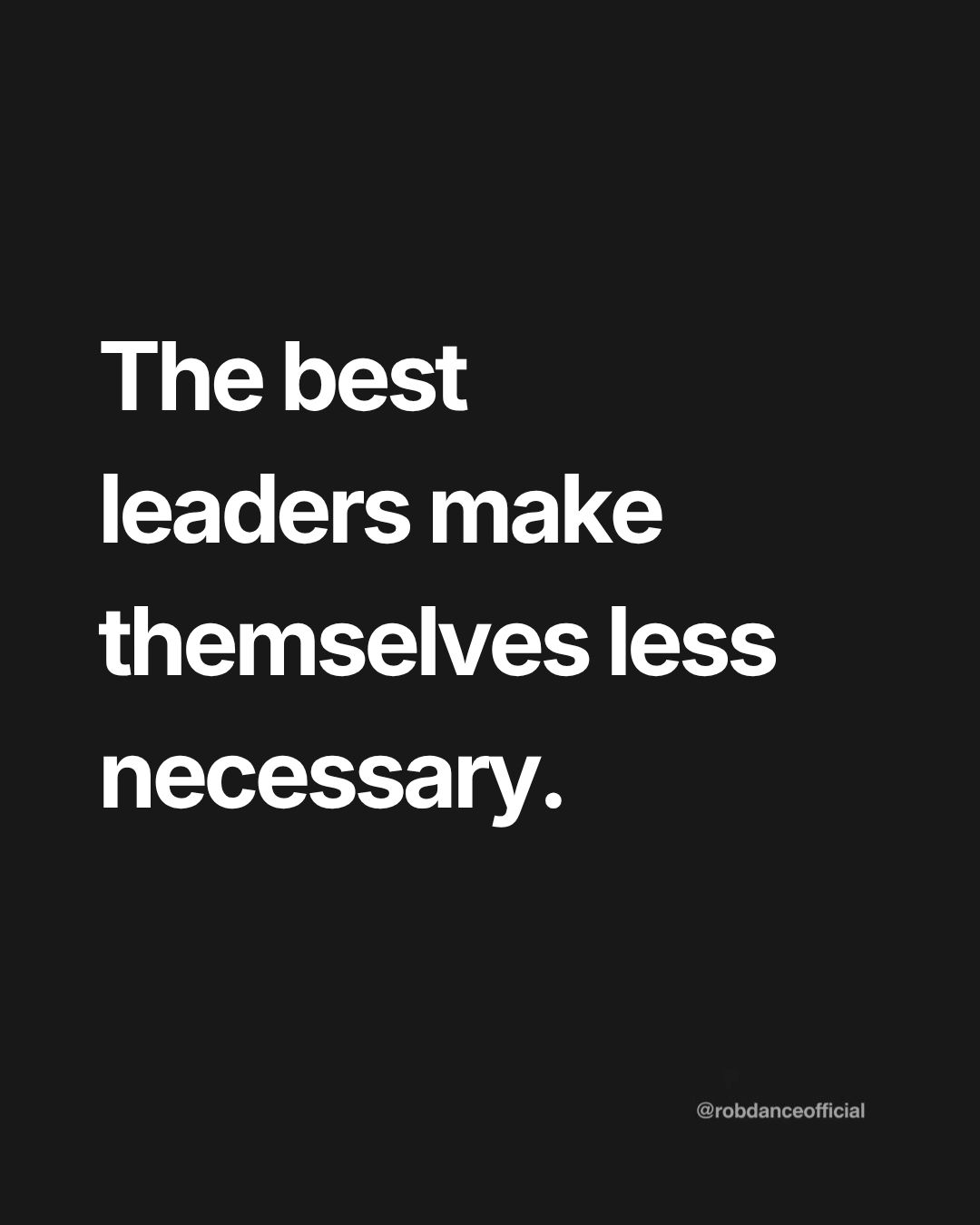
In a recent LinkedIn post, Rob Dance discusses the evolving pressures on CEOs and advocates for a fundamental shift in leadership focus from direct problem-solving to empowering organizational growth. Dance highlights the increasing scrutiny CEOs face, questioning whether this scrutiny is solely focused on traditional metrics like revenue and profit, or if it extends to the less visible, yet critical, decisions made behind closed doors.
The Real Job of a CEO, According to Dance
Dance challenges the notion that a CEO must possess all the answers, a model he deems unsustainable for scaling a business. He elevates the role of leadership to one of cultivation and enablement, emphasizing the importance of developing a robust leadership pipeline within the organization. Citing insights from PwC’s CEO Survey, Dance echoes the sentiment of Lee Perkins, CEO of Civica:
“The number one job for a business leader is to create, support, develop and add new leaders to your organisation.”
This perspective, which Dance strongly agrees with, reframes the CEO’s primary responsibility. It moves away from being the central problem-solver to becoming the architect of an environment where solutions can emerge organically from a capable team.
Building a Scalable Organization
According to Rob Dance, achieving true scalability requires a deliberate organizational design. He argues that the CEO’s role is to foster an environment where talented individuals can make sound decisions independently, without constant oversight or the need to defer to the top for every issue. This requires:
- Establishing clear ownership and accountability across teams.
- Proactively identifying and removing obstacles that hinder progress.
- Focusing on fixing systemic issues rather than merely intervening in individual tasks.
Dance shares that his current focus at ROCK is precisely on this aspect of enablement. He states:
“Enabling people. Making sure everyone has what they need to be successful.”
This approach, as Dance explains, is not about increasing the CEO’s personal importance, but rather about building a company that can thrive and grow independently of its leader’s constant involvement. He posits that this is the ultimate measure of successful scaling.
Shifting the Goal: From CEO Dependence to Company Independence
Rob Dance asserts that the ultimate goal of effective leadership is to create a business that is less dependent on the CEO. This contrasts with a common misconception where leadership is equated with being indispensable. Dance elaborates on this point:
“It’s to build a company that becomes less dependent on you. That’s how you scale.”
This philosophy underscores a mature approach to leadership, where success is measured not by the leader’s direct control, but by the organization’s capacity for autonomous operation and sustained growth. Dance’s insights suggest that the modern CEO’s challenge is to cultivate distributed leadership and empower their teams to drive the business forward, thereby achieving true organizational resilience and scalability.
📝 About This Content
This article is based on insights shared by Rob Dance on LinkedIn.
📅 Originally posted on September 11, 2026 | View original post on LinkedIn →