
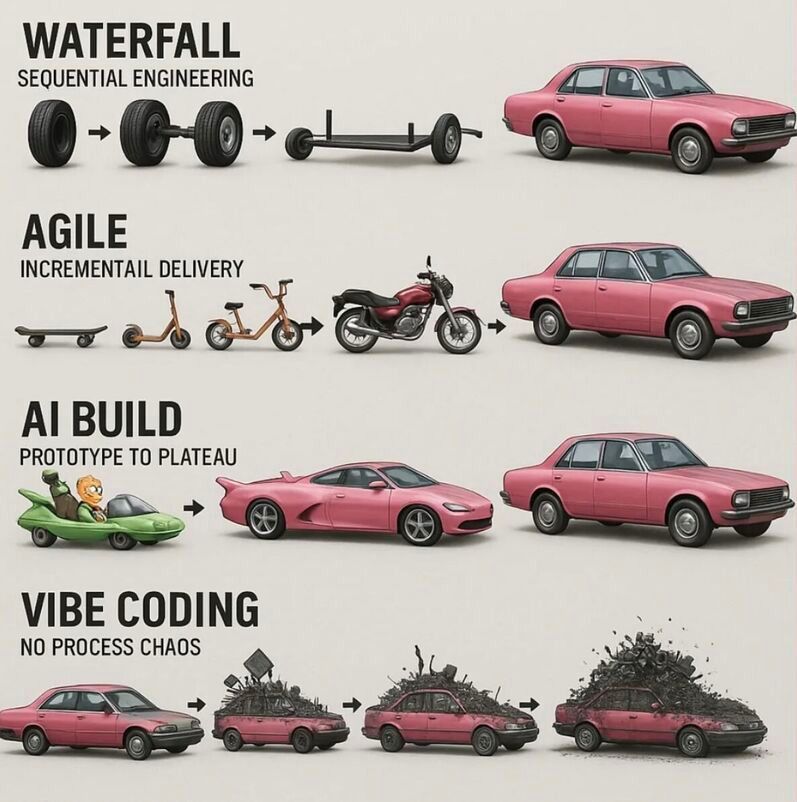
In a recent LinkedIn post, Luís Rodrigues explores the critical distinction between using AI as a tool and relying on it without human oversight, drawing a parallel to the development process. Rodrigues emphasizes that effective AI integration requires a skilled human operator, likening the relationship to that of a craftsman and their tool.
Rodrigues opens by highlighting a personal experience with an AI coding assistant, illustrating the pitfalls of unchecked AI output. He recounts asking an AI to convert a UX design to React code, resulting in a substantial amount of code that was technically functional but ultimately unmaintainable.
“I asked Claude Code to convert a UX design to React code. It created 1,000 lines I couldn’t understand. Not broken. Not wrong. Just impossible to maintain, explain, or extend.”
This experience led Rodrigues to reflect on the process, concluding that the AI’s output lacked the essential human element of thoughtful design and strategic planning. He contrasts the AI’s approach with his own when taking over the task:
“So I stopped prompting and started thinking. I wrote out the component structure I needed. The state management. The layout hierarchy. The edge cases. The result was clean and readable. And mine.”
The Danger of Unsupervised AI Agents
Rodrigues extends this observation to the broader implications of AI agents in development workflows. He warns against the tendency to delegate entire tasks to AI without proper human guidance, a scenario he describes as having a “bigger blast radius” for failure.
According to Rodrigues, a common pitfall is when a single AI agent is responsible for planning, coding, and evaluating its own work. This can lead to a degradation of the original requirements and a loss of project direction over time.
“One agent writes the plan. The same agent writes the code. And the same agent grades the work. The spec from turn 3 is gone by turn 90.”
He argues that simply increasing the complexity of prompts is insufficient to overcome these systemic issues. Instead, Rodrigues proposes the concept of an “agentic graph” as a more robust framework for managing AI in development.
The Need for Human Craftsmanship
Rodrigues asserts that AI, while powerful, remains a tool that requires human expertise to wield effectively. He likens AI agents to the most powerful tools ever created, but stresses that even the best tools are ineffective without a skilled craftsman.
To further elaborate on this concept, Rodrigues is co-teaching a live Packt workshop with Ken Huang on September 29th. The workshop aims to provide hands-on experience in building an “agentic graph,” moving beyond theoretical discussions to practical application.
In essence, Luís Rodrigues advocates for a collaborative approach where AI augments human capabilities rather than replacing human judgment and strategic thinking. His insights underscore the importance of maintaining human control and expertise in the evolving landscape of AI-driven software development.
📝 About This Content
This article is based on insights shared by Luís Rodrigues on LinkedIn.
📅 Originally posted on September 12, 2026 | View original post on LinkedIn →