
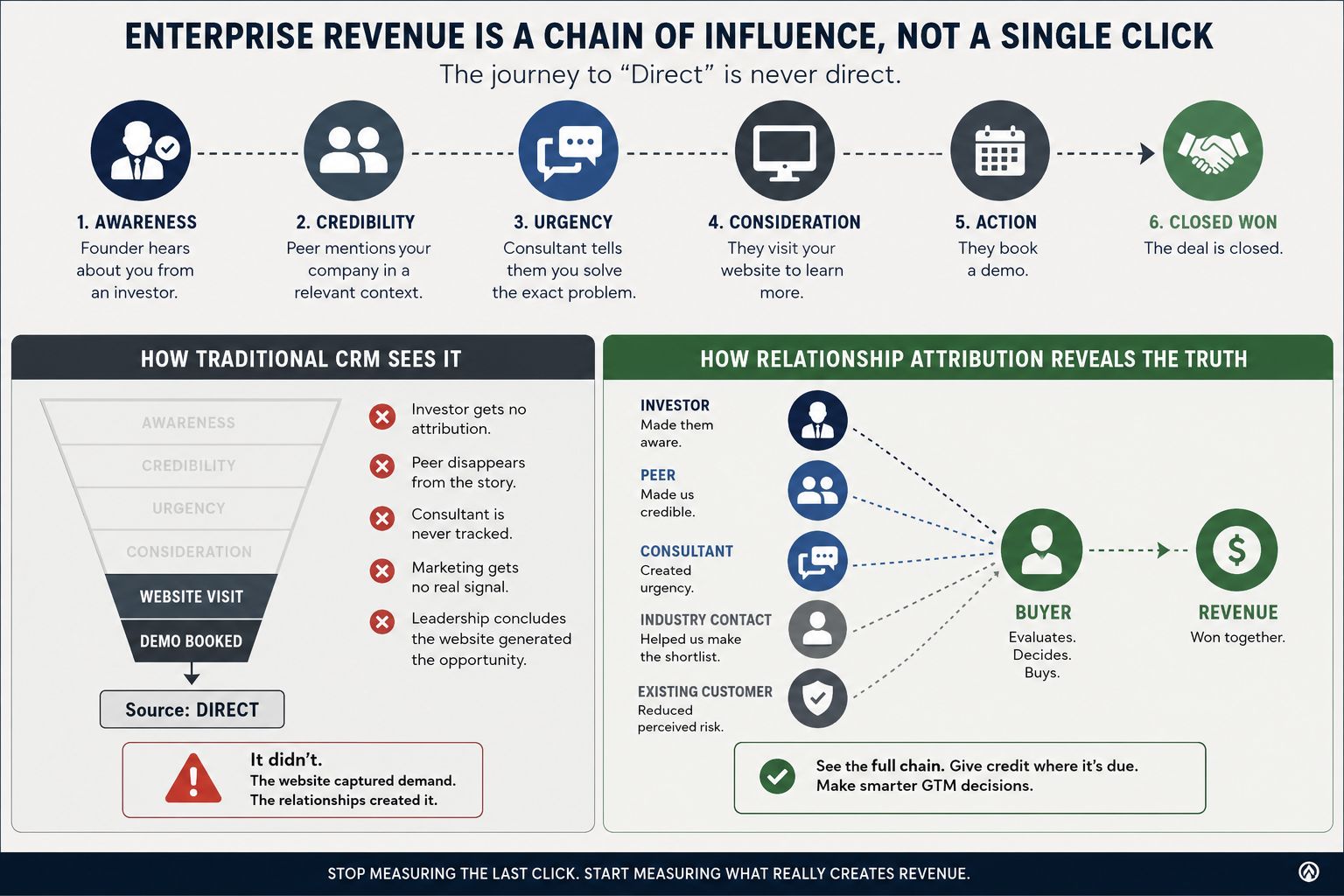
In a recent LinkedIn post, Mario Hernandez highlights a critical flaw in how many companies track their go-to-market (GTM) success, arguing that traditional attribution models often misattribute success to the website rather than the true relationship-driven origins of deals.
Hernandez points out that the “Direct” source in CRMs frequently masks a complex web of influences that actually generate demand. He illustrates this with a common scenario:
“A founder hears about you from an investor. Six weeks later, a peer mentions your company. Then a consultant tells them you solve the exact problem they’re facing. They visit your website. They book a demo. The CRM records: Source: Direct”
This mislabeling, according to Hernandez, leads to significant GTM decision-making errors. Marketing teams receive no meaningful signal, investors and peers are uncredited, and consultants remain invisible in the attribution chain. Consequently, leadership incorrectly concludes that the website, which merely captured demand, was the primary driver of the opportunity.
The Misallocation of GTM Budget
Mario Hernandez argues that this reliance on last-click attribution, where the website is credited for capturing demand, leads to a fundamental misallocation of resources. Companies, he explains, often allocate their budgets based on where a buyer enters the funnel, not on the foundational relationships that initiated the buying process.
“The website captured demand. The relationships created it,” Hernandez emphasizes. This distinction is crucial, as the moments of initial awareness and credibility building are often far removed from the final website interaction.
Unpacking the True Drivers of Enterprise Deals
Hernandez proposes a more nuanced approach to understanding deal genesis. He suggests that for any significant deal, a company should seek to identify the specific touchpoints and individuals responsible for different stages of the buyer’s journey. He poses several key questions that traditional attribution models fail to address:
- Who first made the buyer aware of us?
- Who made us credible?
- Who created urgency?
- Who helped us make the shortlist?
- Who reduced perceived risk?
According to Hernandez, traditional attribution systems typically assign credit to a single source, failing to recognize the cumulative effect of multiple influences.
“Enterprise buying rarely works that way. Revenue is often created by a chain of influence.”
This chain of influence, often involving investors, peers, consultants, and other trusted advisors, plays a pivotal role in building trust, establishing credibility, and navigating the complexities of enterprise sales. Without visibility into this chain, businesses are left with an incomplete and often misleading picture of their GTM effectiveness.
Beyond the Last Click: Measuring Real GTM Impact
Hernandez concludes his post by asserting that true GTM measurement requires looking beyond the final interaction. He states:
“Until you can see that chain, you’re not really measuring GTM. You’re measuring the last click.”
His insights challenge businesses to re-evaluate their attribution strategies, urging them to invest in understanding the full spectrum of influences that contribute to customer acquisition. By recognizing and tracking this ‘chain of influence,’ companies can gain a more accurate understanding of their GTM channels, leading to more effective strategies and better-informed resource allocation.
📝 About This Content
This article is based on insights shared by Mario Hernandez on LinkedIn.
📅 Originally posted on July 28, 2026 | View original post on LinkedIn →