
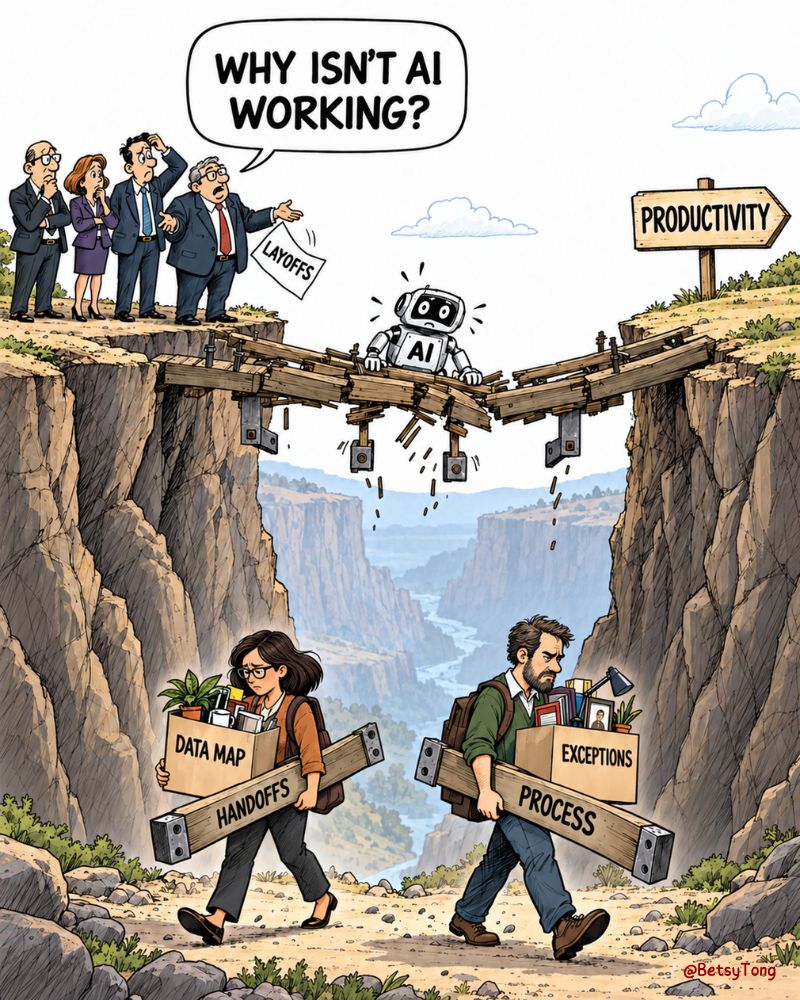
In a recent LinkedIn post, Betsy Tong explores a critical paradox emerging in the wake of corporate AI adoption: the elimination of the very human expertise needed to make these advanced systems function effectively. Tong argues that many companies, in their haste to implement AI and reduce headcount, have inadvertently removed the individuals who understand and manage the complex, often unwritten, processes that AI relies upon.
The post highlights a common, yet often overlooked, consequence of recent layoffs. Tong points out that it wasn’t necessarily the executive leadership, but the frontline workers who possessed the deep operational knowledge, that were let go.
“It wasn’t the execs who got laid off. It was the ones who did the work. You can fire the people. You can’t fire the work.”
This fundamental misunderstanding, according to Tong, leads to significant implementation challenges. Companies often celebrate AI wins prematurely, only to discover that the essential groundwork for AI success—data integrity, process documentation, user training, and change management—is left unaddressed. Without the people who previously managed these areas, the AI systems falter.
The Unseen Labor Behind AI Functionality
Betsy Tong emphasizes that AI systems are not plug-and-play solutions. They require robust data pipelines, clear processes, and human oversight, especially in nuanced decision-making. Tong illustrates this with several examples:
Data Discrepancies and Lost Expertise
One significant hurdle identified by Tong is the state of customer data. She notes that data often resides in disparate systems, frequently containing conflicting information. The loss of individuals like ‘Linda,’ who previously translated and reconciled this data, leaves a critical gap.
“1️⃣ Customer data sitting in three systems. All three disagree with each other. Linda translated them. Her last day was in May.”
As Tong explains, this kind of data wrangling is essential for AI to function accurately, and the people who performed these tasks are often the first to be cut.
Process Gaps and the Need for Human Judgment
Another area where Tong sees AI implementation failing is in processes that were never formally documented. She references a scenario at UnitedHealth where AI agents were tasked with claims processing. The AI’s rigid decision-making led to a high rate of denials, requiring human intervention to correct.
“The AI denied, denied, denied. Humans reversed 9 out of 10 AI’s denials because decisions require judgment.”
This highlights that AI, while powerful, often lacks the nuanced judgment and understanding of context that human employees possess. When the individuals who understood these unwritten rules and exceptions are gone, the AI’s effectiveness is severely hampered.
Adoption Hurdles and the Willingness to Engage
Tong also points out that successful AI implementation isn’t just about deploying technology; it’s about user adoption. She criticizes the common metric of counting ‘seats deployed’ without considering whether employees are actually willing and able to use the new systems. The expertise of individuals like ‘Tom,’ who could intuitively navigate and utilize these tools, is lost when they are laid off.
The Bottleneck Remover
Ultimately, Betsy Tong argues that companies are mistakenly identifying bottlenecks and then removing the person who understood how to navigate or fix them. The individuals who knew the intricacies of the ‘handoff to finance’ or where ‘approval delays’ occurred are precisely the ones being let go.
In Tong’s view, these employees were not just cogs in a machine; they were the ‘data pipeline,’ the ‘judgment,’ and the ‘knowledge’ that made complex systems work. The irony, she concludes, is that many of these now-unemployed individuals are still actively seeking opportunities, as evidenced by ‘Linda’s’ LinkedIn profile.
Follow Betsy Tong for more insights on how AI truly works in practice.
📝 About This Content
This article is based on insights shared by Betsy Tong on LinkedIn.
📅 Originally posted on September 11, 2026 | View original post on LinkedIn →