
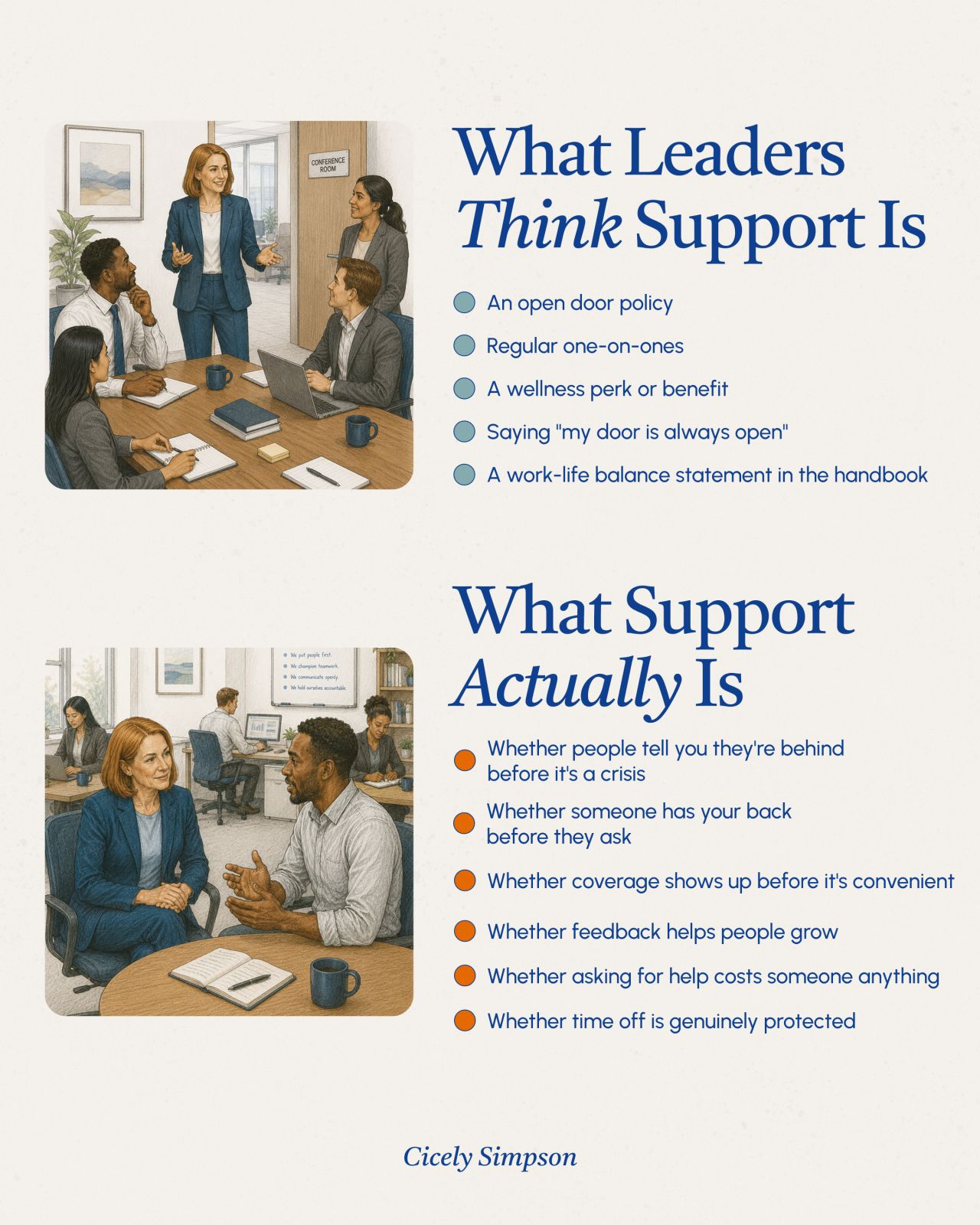
In a recent LinkedIn post, Cicely Simpson challenges conventional notions of leadership support, arguing that the true measure lies not in stated policies but in the lived experiences of team members during times of genuine struggle. Simpson emphasizes that many leaders may believe they offer robust support, but this is only truly tested when employees face adversity.
The Crucial Difference Between Stated and Experienced Support
Simpson highlights a common disconnect where leaders may tout open doors and supportive one-on-ones, yet this doesn’t reveal how they react when things go wrong. “What someone experiences when things go wrong tells you more about your support than anything you say when things are going fine,” Simpson states, underscoring the critical importance of actions over pronouncements.
“A lot of leaders never find this out until it is too late.”
The post outlines specific scenarios that reveal this gap:
When ‘Open Doors’ Lead to Hidden Problems
Simpson points out that if employees only bring good news to a leader, it suggests a culture where problems are concealed until they become unmanageable. This is a direct consequence of how leaders respond to initial challenges. As Simpson notes, this scenario occurs when “people only come to you with good news” because “you have built a culture where problems get hidden until they are too big to fix easily.”
The Cost of Asking for Help
Another critical area Simpson identifies is the perception of asking for assistance. If an employee who sought help was told to “figure it out themselves,” they learn that seeking support has a higher cost than its potential benefit. Simpson argues that in such cases, leaders have effectively “taught your team that asking for help costs more than it is worth.”
Work-Life Balance: A Matter of Action, Not Just Words
The perception of work-life balance is also critically examined. Simpson suggests that leaders who answer emails at 1 am or reward those who work the latest are sending a clear message that visibility trumps boundaries. This behavior demonstrates that “you have shown your team that visibility matters more than boundaries,” contradicting stated commitments to balance.
Providing Genuine Support: Actionable Strategies
Simpson proposes concrete actions leaders can take to genuinely support their teams, moving beyond mere rhetoric. These include:
- Proactively noticing when someone is struggling before they have to ask.
- Creating an environment where admitting to falling behind is acceptable without negative repercussions.
- Ensuring coverage is available when life events occur, not just when it’s convenient.
- Demonstrating a leader has their team’s back preemptively.
- Offering feedback that fosters growth and critical thinking.
- Protecting time, not just offering it.
According to Simpson, closing this gap between stated intentions and experienced reality is key to retention. “Because a lot of retention problems come down to people feeling alone in the workload, instead of the workload itself,” she writes. Leaders who consistently back up their words with actions, especially when it involves personal cost, foster loyalty and purpose.
“The gap between what you say and what your team experiences day to day is the truest measure of how supported they feel.”
Simpson concludes by inviting leaders to consider this crucial distinction and offers her LeaderOS program as a resource for those seeking to build a more effective leadership system focused on genuine support.
📝 About This Content
This article is based on insights shared by Cicely Simpson on LinkedIn.
📅 Originally posted on September 14, 2026 | View original post on LinkedIn →