
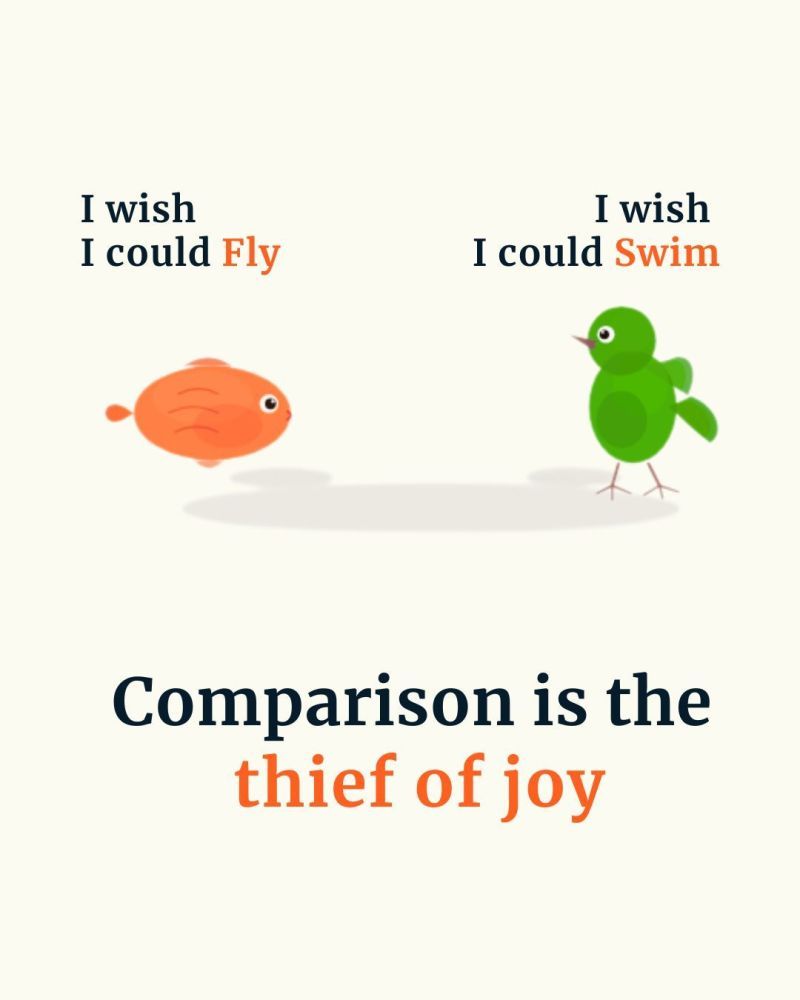
In a recent LinkedIn post, Janet Kim discusses the common feeling of being ‘behind’ in one’s career and argues that this perception often stems from comparing oneself in the wrong context. Kim challenges the conventional narrative of competitive advancement, suggesting that individuals frequently misinterpret their progress by measuring it against arbitrary or mismatched benchmarks.
Kim highlights the subtle yet powerful impact of social media and workplace comparisons. “You scroll and see someone doing more. Earning more. Seeming more certain. And it quietly shifts how you see yourself,” she writes, illustrating how external observations can distort self-perception.
“But here’s what nobody says about comparison: It looks precise. It isn’t.”
The core of Kim’s argument is that individuals often find themselves feeling inadequate not due to a lack of ability, but because they are evaluating themselves based on the wrong criteria. She uses the analogy of a fish comparing itself to a bird to underscore this point.
The Mismatch of Professional Arenas
Kim elaborates on how different professional environments can drastically alter how one’s contributions are perceived and valued. She points out that the same individual can feel insecure in one setting while being highly respected in another, without any change in their fundamental skills or experience.
“In one room, you feel inexperienced. In another, people are waiting for your opinion. In one role, you feel invisible. In another, your judgment quietly sets the pace,” Kim observes. This disparity, she contends, is not a reflection of personal failing but of the differing frames of reference in each environment.
Identifying True Signals of Progress
According to Kim, genuine indicators of professional growth and impact are often present but overlooked when one is caught in a cycle of negative comparison. She suggests that these signals manifest in how others implicitly trust and rely on an individual’s judgment and expertise.
“People trusting your judgment without saying it. Others waiting for your signal before moving forward. Your experience quietly shaping decisions.”
These subtle cues, Kim argues, are the accurate measures of one’s standing and influence. The challenge lies in recognizing and valuing these internal signals rather than external, often misleading, comparisons.
Comparison’s Incomplete Nature
Janet Kim concludes that the detrimental effect of comparison isn’t its harshness, but its inherent incompleteness. By focusing on selective or mismatched metrics, individuals miss the full picture of their achievements and capabilities.
“Comparison doesn’t steal joy because it’s harsh. It steals it because it’s incomplete.”
Kim emphasizes that gaining the right perspective is not about forced optimism but about achieving accuracy in self-assessment. By understanding the context and arena in which one is operating, individuals can move away from feelings of inadequacy and towards a more realistic and empowering view of their professional journey.
📝 About This Content
This article is based on insights shared by Janet Kim on LinkedIn.
📅 Originally posted on August 16, 2026 | View original post on LinkedIn →